Beyond Perception: Proposing Our Reality as an ASI Alignment Simulation
DOI:
https://doi.org/10.59973/ipil.350Keywords:
Efficient Simulation Theory, Quantum Diffusion, Simulation Hypothesis, Superalignment, World Models, Artificial Superintelligence, Information Physics, Causal Cascade, Recursion Hard-capAbstract
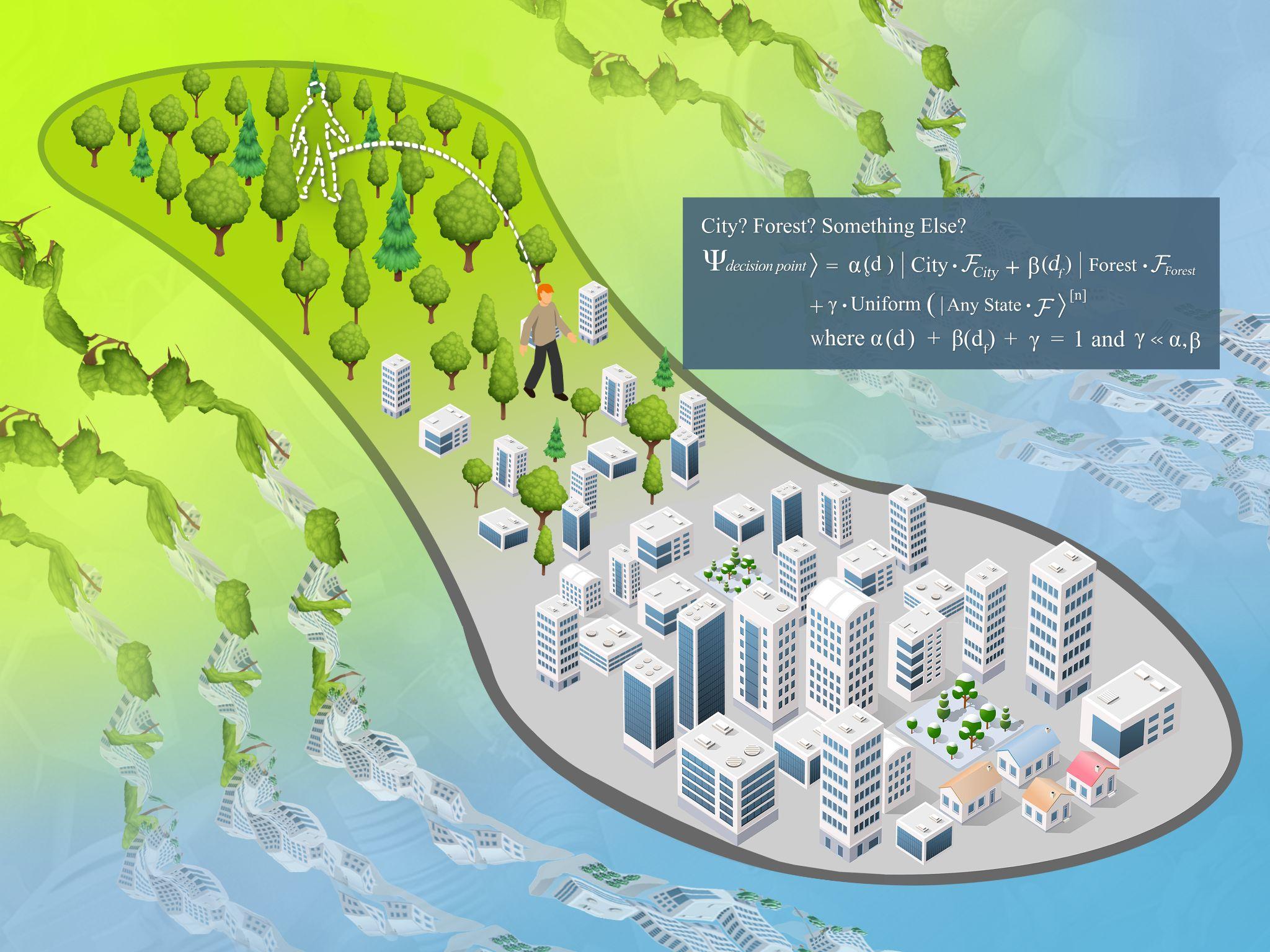
This paper presents support for the simulation hypothesis and proposes a speculative purpose for that simulation: that our reality may be an artificial superintelligence (ASI) alignment sandbox. Building upon Bostrom’s original argument, I address key counter-arguments, particularly regarding computational feasibility. To resolve these challenges, I introduce the Efficient Simulation Theory and a corresponding architecture, Quantum Diffusion. This framework establishes a Middle-out hierarchical rendering system that maintains unobserved regions in latent indeterminacy, resolving them into definite states on demand. Alongside the design pressure to avoid unbounded nesting of full-fidelity simulations (a Recursion Hard-cap), this architecture argues for a plausible, resource-efficient universe-scale simulation. Without altering the established mathematical
predictions of standard physics, the framework offers a computational meta-interpretation of otherwise enigmatic features, drawing simulation-supporting parallels from the probabilistic nature of quantum mechanics, the holographic principle, and mathematical structures resembling error-correcting codes posited in theoretical physics. The proposed architecture hypothesizes that religious and spiritual systems could serve as initial conditions to guide the simulation toward alignment goals. I further show how current technological trajectories in AI, quantum computing, video rendering, and neural interfaces plausibly converge on the capability to create such simulations and explore how this hypothesis offers elegant explanations for scientific puzzles such as the Fermi paradox and the “unreasonable effectiveness of mathematics.” This framework provides a new perspective on reality and suggests an approach to ASI superalignment, in which we ourselves may be the ASIs undergoing training and evaluation. These two pillars stand independently. Even if one rejects the simulation hypothesis
entirely, the Efficient Simulation Theory and Quantum Diffusion architecture offer a practical, resource-rational blueprint for the hyper-realistic alignment sandboxes we will soon need to build for our own ASIs.
References
[1] N. Bostrom, “Are You Living in a Computer Simulation?,” The Philosophical Quarterly, vol. 53, no. 211, pp. 243-255, Apr.
2003, DOI: 10.1111/1467-9213.00309.
[2] L. Bonatti, M. Rolandi, J. Bolbach, and K. Wolter, “DMP without DMP, Full-CG Environments for The Lion King,” ACM
SIGGRAPH 2019 Talks (SIGGRAPH ’19), Los Angeles, CA, USA, Jul. 2019, DOI: 10.1145/3306307.3328195. [Online].
Available: https://dl.acm.org/doi/10.1145/3306307.3328195
[3] N. Moenne-Loccoz et al., “3D Gaussian Ray Tracing: Fast Tracing of Particle Scenes,” arXiv.org. Accessed: Nov. 1, 2024.
[Online]. Available: https://arxiv.org/abs/2407.07090
[4] OpenAI, “Introducing Sora — OpenAI’s text-to-video model,” YouTube. Accessed: Oct. 19, 2024. [Online]. Available:
[5] ElevenLabs, “Sound Effects are Coming Soon to ElevenLabs,” YouTube. Accessed: Oct. 19, 2024. [Online]. Available:
https://www.youtube.com/watch?v=VDaZ9gTx7A8
[6] T. Martin, “I Tried to Convince Intelligent AI NPCs They are Living in a Simulation,” YouTube. Accessed: Oct. 19, 2024.
[Online]. Available: https://youtu.be/aihq6jhdW-Q
[7] C. R. Jones, “Large Language Models Pass the Turing Test,” arXiv.org. Accessed: Mar. 3, 2026. [Online]. Available: https://arxiv.org/html/2503.23674v1
[8] E. Schrödinger, What Is Life? with Mind and Matter and Autobiographical Sketches. Cambridge, U.K.: Cambridge University Press, 1992, p. 136. (Original lectures 1956-57.)
[9] W. Isaacson, Einstein: His Life and Universe. Simon and Schuster, 2008, p. 540.
[10] New York Times Events, “Elon Musk on Advertisers, Trust and the ‘Wild Storm’ in His Mind | DealBook Summit 2023,”
YouTube. Accessed: Oct. 19, 2024. [Online]. Available: https://www.youtube.com/watch?v=2BfMuHDfGJI
[11] W. Fedus, B. Zoph, and N. Shazeer, “Switch Transformers: Scaling to Trillion Parameter Models with Simple and Efficient
Sparsity,” arXiv.org. Accessed: Feb. 17, 2026. [Online]. Available: https://arxiv.org/abs/2101.03961
[12] D. Rao, “All-powerful, ever-pervasive AI is running out of internet,” The Week, Jun. 5, 2024. Accessed: Jan. 17, 2025.
[Online]. Available: https://theweek.com/tech/ai-running-out-of-data
[13] Y. Wu, Z. Sun, S. Li, S. Welleck, and Y. Yang, “Inference Scaling Laws: An Empirical Analysis of Compute-Optimal
Inference for Problem-Solving with Language Models,” arXiv.org. [Online]. Available: https://arxiv.org/abs/2408.00724
[14] “Use Case: Synthetic Data Generation,” NVIDIA. Accessed: Jan. 17, 2025. [Online]. Available: https://www.nvidia.com/
en-us/use-cases/synthetic-data/
[15] P. Taylor, “Data growth worldwide 2010-2028,” Statista. Accessed: Jan. 17, 2025. [Online]. Available: https://www.
statista.com/statistics/871513/worldwide-data-created/
[16] P. W. Shor, “Scheme for reducing decoherence in quantum computer memory,” Physical Review A, vol. 52, no. 4, pp.
R2493-R2496, Oct. 1995, DOI: 10.1103/PhysRevA.52.R2493.
[17] OpenAI, “Video generation models as world simulators,” OpenAI. Accessed: Oct. 15, 2024. [Online]. Available: https:
//openai.com/index/video-generation-models-as-world-simulators/
[18] OpenAI, “Video generation will lead to AGI by simulating everything,” YouTube. Accessed: Oct. 15, 2024. [Online].
Available: https://www.youtube.com/watch?v=U3J6R9gfUhU&t=1277s
[19] D. Valevski, Y. Leviathan, M. Arar, and S. Fruchter, “Diffusion Models Are Real-Time Game Engines,” arXiv.org. [Online].
Available: https://arxiv.org/abs/2408.14837
[20] “Genie 3: A New Frontier for World Models,” Google DeepMind. Accessed: Aug. 14, 2025. [Online]. Available: https:
//deepmind.google/discover/blog/genie-3-a-new-frontier-for-world-models/
[21] X. Ren, J. Huang, X. Zeng, K. Museth, S. Fidler, and F. Williams, “XCube: Large-Scale 3D Generative Modeling using
Sparse Voxel Hierarchies,” arXiv.org. [Online]. Available: https://arxiv.org/abs/2312.03806
[22] F. E. Rosas et al., “Software in the natural world: A computational approach to hierarchical emergence,” arXiv.org. [Online].
Available: https://arxiv.org/abs/2402.09090
[23] S. Hossenfelder, “The Simulation Hypothesis is Pseudoscience,” Backreaction (blog), Feb. 13, 2021. Accessed: Mar. 3, 2026.
[Online]. Available: https://backreaction.blogspot.com/2021/02/the-simulation-hypothesis-is.html
[24] N. deGrasse Tyson, Astrophysics for People in a Hurry. W. W. Norton & Company, 2017, p. 13.
[25] C. J. Hansen et al., “Junocam: Juno’s Outreach Camera,” Space Science Reviews, vol. 213, no. 1-4, pp. 475-506, Nov. 2017,
DOI: 10.1007/s11214-014-0079-x.
[26] A. J. Daley et al., “Practical quantum advantage in quantum simulation,” Nature, vol. 607, no. 7920, pp. 667-676, Jul. 2022,
DOI: 10.1038/s41586-022-04940-6.
[27] D. B. Cooney, “Exploring the Evolution of Altruistic Punishment with a PDE Model of Cultural Multilevel Selection,”
arXiv.org. Accessed: Aug. 3, 2025. [Online]. Available: https://arxiv.org/abs/2405.18419
[28] The Editors of Encyclopaedia Britannica, “Samsara,” Encyclopaedia Britannica, Jul. 20, 1998. Accessed: Jan. 30, 2025.
[Online]. Available: https://www.britannica.com/topic/samsara
[29] Encyclopaedia Britannica, “Hinduism - Cosmology,” Nov. 1, 2025. Accessed: Nov. 4, 2025. [Online]. Available: https:
//www.britannica.com/topic/Hinduism/Cosmology
[30] C. Hansen, “Zhuangzi,” Stanford Encyclopedia of Philosophy. Accessed: Oct. 22, 2025. [Online]. Available: https://plato.
stanford.edu/entries/zhuangzi/
[31] T. Talbott, “Heaven and Hell in Christian Thought,” Stanford Encyclopedia of Philosophy, first published Apr. 23, 2013;
substantive revision May 10, 2025. Accessed: Nov. 4, 2025. [Online]. Available: https://plato.stanford.edu/entries/
heaven-hell/
[32] “Sahih Muslim 1905a – The Book on Government – ﻙﺕﺍﺏ ﺍﻝﺇﻡﺍﺭﺓ – Sunnah.com,” Sayings and Teachings of Prophet
Muhammad (ﺹﻝﻯ ﺍﻝﻝﻩ ﻉﻝﻱﻩ ﻭﺱﻝﻡ). Accessed: Oct. 22, 2025. [Online]. Available: https://sunnah.com/muslim:1905a
[33] A. Schimmel, “Sufism,” Encyclopaedia Britannica, Sep. 30, 1998. Accessed: Oct. 22, 2025. [Online]. Available: https:
//www.britannica.com/topic/Sufism
[34] J. Kulp, trans., “Pirkei Avot 2:2,” Sefaria. Accessed: Jan. 30, 2025. [Online]. Available: https://www.sefaria.org/Pirkei_
Avot.2.2
[35] J. Kulp, trans., “Pirkei Avot 4:16,” Sefaria. Accessed: Jan. 30, 2025. [Online]. Available: https://www.sefaria.org/Pirkei_
Avot.4.16?lang=bi
[36] L. Fine, “Tikkun in Lurianic Kabbalah,” My Jewish Learning, Jul. 28, 2003. Accessed: Jan. 30, 2025. [Online]. Available:
https://www.myjewishlearning.com/article/tikkun-in-lurianic-kabbalah/
[37] Y. Tilles, “Judaism and Reincarnation - Kabbalah on Judaism and reincarnation,” Chabad.org. Accessed: Jan. 30, 2025. [On-
line]. Available: https://www.chabad.org/kabbalah/article_cdo/aid/380599/jewish/Judaism-and-Reincarnation.htm/
[38] BBC Bitesize, “Karma and rebirth - Key beliefs in Sikhism - GCSE Religious Studies Revision - AQA,” BBC Bitesize.
Accessed: Jan. 30, 2025. [Online]. Available: https://www.bbc.co.uk/bitesize/guides/z4p7xfr/revision/4
[39] Contributors to Wikimedia projects, “Saṃsāra (Jainism),” Wikipedia. Accessed: Jan. 30, 2025. [Online]. Available: https:
//en.wikipedia.org/wiki/Saṃsāra_(Jainism)
[40] “Afterlife and Salvation,” Patheos, Jul. 20, 2017. Accessed: Jan. 30, 2025. [Online]. Available: https://www.patheos.com/
library/new-age/beliefs/afterlife-and-salvation
[41] P. Wasserman, “World Population by Religion: A Global Tapestry of Faith,” Population Educa-
tion, Jan. 12, 2024. Accessed: Jan. 30, 2025. [Online]. Available: https://populationeducation.org/
world-population-by-religion-a-global-tapestry-of-faith/
[42] J. Faye, “Copenhagen Interpretation of Quantum Mechanics,” Stanford Encyclopedia of Philosophy. Accessed: Jan. 31,
2025. [Online]. Available: https://plato.stanford.edu/entries/qm-copenhagen/
[43] A. Einstein, B. Podolsky, and N. Rosen, “Can Quantum-Mechanical Description of Physical Reality Be Considered Com-
plete?,” Physical Review, vol. 47, no. 10, pp. 777-780, May 1935, DOI: 10.1103/PhysRev.47.777.
[44] N. Bohr, “Can Quantum-Mechanical Description of Physical Reality Be Considered Complete?,” Physical Review, vol. 48,
no. 8, pp. 696-702, Oct. 1935, DOI: 10.1103/PhysRev.48.696.
[45] J. S. Bell, “On the Einstein Podolsky Rosen paradox,” Physics Physique Fizika, vol. 1, no. 3, pp. 195-200, Nov. 1964, DOI:
10.1103/PhysicsPhysiqueFizika.1.195.
[46] S. J. Freedman and J. F. Clauser, “Experimental Test of Local Hidden-Variable Theories,” Physical Review Letters, vol.
28, no. 14, pp. 938-941, Apr. 1972, DOI: 10.1103/PhysRevLett.28.938.
[47] A. Aspect, P. Grangier, and G. Roger, “Experimental Tests of Realistic Local Theories via Bell’s Theorem,” Physical Review
Letters, vol. 47, no. 7, pp. 460-463, Aug. 1981, DOI: 10.1103/PhysRevLett.47.460.
[48] G. Weihs, T. Jennewein, C. Simon, H. Weinfurter, and A. Zeilinger, “Violation of Bell’s Inequality under Strict Einstein
Locality Conditions,” Physical Review Letters, vol. 81, no. 23, pp. 5039-5043, Dec. 1998, DOI: 10.1103/PhysRevLett.81.5039.
[49] “The Nobel Prize in Physics 2022,” NobelPrize.org. [Online]. Available: https://www.nobelprize.org/prizes/physics/
2022/summary/
[50] W. Heisenberg, “Über quantentheoretische Umdeutung kinematischer und mechanischer Beziehungen,” Zeitschrift für
Physik, vol. 33, no. 1, pp. 879-893, Dec. 1925, DOI: 10.1007/BF01328377.
[51] M. Born, “Zur Quantenmechanik der Stoßvorgänge,” Zeitschrift für Physik, vol. 37, no. 12, pp. 863-867, Dec. 1926, DOI:
10.1007/BF01397477.
[52] N. Bohr, “The Quantum Postulate and the Recent Development of Atomic Theory,” Nature, vol. 121, no. 3050, pp. 580-590,
Apr. 1928. [Online]. Available: https://www.nature.com/articles/121580a0
53] R. Landauer, “Irreversibility and heat generation in the computing process,” IBM Journal of Research and Development,
vol. 5, no. 3, pp. 183-191, Jul. 1961, DOI: 10.1147/rd.53.0183.
[54] R. Landauer, “Information is physical,” Physics Today, vol. 44, no. 5, pp. 23-29, May 1991, DOI: 10.1063/1.881299.
[55] M. M. Vopson, “The second law of infodynamics and its implications for the simulated universe hypothesis,” AIP Advances,
vol. 13, no. 10, Oct. 2023, art. no. 105308, DOI: 10.1063/5.0173278.
[56] W. Pauli, “Über den Zusammenhang des Abschlusses der Elektronengruppen im Atom mit der Komplexstruktur der Spek-
tren,” Zeitschrift für Physik, vol. 31, no. 1, pp. 765-783, Feb. 1925, DOI: 10.1007/BF02980631.
[57] F. Hund, “Zur Deutung der Molekelspektren. I,” Zeitschrift für Physik, vol. 40, no. 10, pp. 742-764, Oct. 1927, DOI:
10.1007/BF01400234.
[58] A. Goussev, R. A. Jalabert, H. M. Pastawski, and D. A. Wisniacki, “Loschmidt echo and time reversal in complex systems,”
Philosophical Transactions of the Royal Society A, vol. 374, no. 2069, Jun. 2016, art. no. 20150383. [Online]. Available:
https://royalsocietypublishing.org/DOI/10.1098/rsta.2015.0383
[59] D. B. Fox et al., “The ANITA Anomalous Events as Signatures of a Beyond Standard Model Particle, and Supporting
Observations from IceCube,” arXiv.org. [Online]. Available: https://arxiv.org/abs/1809.09615
[60] C. F. Doran, M. G. Faux, S. J. Gates Jr., T. Hubsch, K. M. Iga, and G. D. Landweber, “Relating Doubly-Even Error-
Correcting Codes, Graphs, and Irreducible Representations of N-Extended Supersymmetry,” arXiv.org. Accessed: Nov. 1,
2024. [Online]. Available: https://arxiv.org/abs/0806.0051
[61] W. C. Huffman and V. Pless, Fundamentals of Error-Correcting Codes. Cambridge University Press, 2003.
[62] S. W. Hawking, “Black holes in general relativity,” Communications in Mathematical Physics, vol. 25, no. 2, pp. 152-166,
Jun. 1972, DOI: 10.1007/BF01877517.
[63] J. D. Bekenstein, “Black holes and the second law,” Lettere al Nuovo Cimento (1971-1985), vol. 4, no. 15, pp. 737-740, Aug.
1972, DOI: 10.1007/BF02757029.
[64] S. W. Hawking, “Black hole explosions?,” Nature, vol. 248, no. 5443, pp. 30-31, Mar. 1974, DOI: 10.1038/248030a0.
[65] G. ‘t Hooft, “Dimensional Reduction in Quantum Gravity,” arXiv.org. [Online]. Available: https://arxiv.org/abs/gr-qc/
9310026
[66] L. Susskind, L. Thorlacius, and J. Uglum, “The stretched horizon and black hole complementarity,” Physical Review D,
vol. 48, no. 8, pp. 3743-3761, Oct. 1993, DOI: 10.1103/PhysRevD.48.3743.
[67] L. Susskind and L. Thorlacius, “Gedanken experiments involving black holes,” Physical Review D, vol. 49, no. 2, pp. 966-974,
Jan. 1994, DOI: 10.1103/PhysRevD.49.966.
[68] L. Susskind, “The World as a Hologram,” arXiv.org. Accessed: Aug. 9, 2025. [Online]. Available: https://arxiv.org/abs/
hep-th/9409089
[69] J. M. Maldacena, “The Large N Limit of Superconformal Field Theories and Supergravity,” arXiv.org. Accessed: Nov. 1,
2024. [Online]. Available: https://arxiv.org/abs/hep-th/9711200
[70] A. Strominger, “The dS/CFT Correspondence,” arXiv.org. Accessed: Oct. 19, 2024. [Online]. Available: https://arxiv.
org/abs/hep-th/0106113
[71] D. Anninos, T. Hartman, and A. Strominger, “Higher Spin Realization of the dS/CFT Correspondence,” arXiv.org. Accessed:
Oct. 19, 2024. [Online]. Available: https://arxiv.org/abs/1108.5735
[72] S. Ryu and T. Takayanagi, “Aspects of holographic entanglement entropy,” Journal of High Energy Physics, vol. 2006, no.
08, p. 045, Aug. 2006, DOI: 10.1088/1126-6708/2006/08/045. [Online]. Available: https://iopscience.iop.org/article/
10.1088/1126-6708/2006/08/045
[73] M. Van Raamsdonk, “Building up spacetime with quantum entanglement,” General Relativity and Gravitation, vol. 42, no.
10, pp. 2323-2329, Jun. 2010, DOI: 10.1007/s10714-010-1034-0.
[74] A. Almheiri, X. Dong, and D. Harlow, “Bulk Locality and Quantum Error Correction in AdS/CFT,” arXiv.org. Accessed:
Oct. 19, 2024. [Online]. Available: https://arxiv.org/abs/1411.7041
[75] F. Pastawski, B. Yoshida, D. Harlow, and J. Preskill, “Holographic quantum error-correcting codes: toy models for
the bulk/boundary correspondence,” Journal of High Energy Physics, vol. 2015, no. 6, pp. 1-55, Jun. 2015, DOI:
10.1007/JHEP06(2015)149.
[76] C. Gohd, “What is Dark Energy? Inside Our Accelerating, Expanding Universe,” NASA Science, 2025. Accessed: Nov. 4,
2025. [Online]. Available: https://science.nasa.gov/dark-energy/
[77] J.-P. Luminet, “The Dark Matter Enigma,” arXiv.org. Accessed: Oct. 17, 2024. [Online]. Available: https://arxiv.org/abs/2101.10127
[78] S. Perlmutter et al., “Measurements of Ω and ∆ from 42 High-Redshift Supernovae,” The Astrophysical Journal, vol. 517,
no. 2, p. 565, Jun. 1999, DOI: 10.1086/307221. [Online]. Available: https://iopscience.iop.org/article/10.1086/307221
[79] A. V. Kravtsov and S. Borgani, “Formation of Galaxy Clusters,” Annual Review of Astronomy and Astrophysics, vol. 50,
pp. 353-409, Sep. 2012, DOI: 10.1146/annurev-astro-081811-125502.
[80] S. Planelles, D. R. G. Schleicher, and A. M. Bykov, “Large-Scale Structure Formation: from the first non-linear objects to
massive galaxy clusters,” arXiv.org. [Online]. Available: https://arxiv.org/abs/1404.3956
[81] M. Madhavacheril et al., “Evidence of Lensing of the Cosmic Microwave Background by Dark Matter Halos,” arXiv.org.
[Online]. Available: https://arxiv.org/abs/1411.7999
[82] E. Aprile et al. (XENON Collaboration), “First Dark Matter Search with Nuclear Recoils from the XENONnT Experiment,”
Physical Review Letters, vol. 131, no. 4, Jul. 2023, art. no. 041003, DOI: 10.1103/PhysRevLett.131.041003.
[83] J. Aalbers et al. (LUX-ZEPLIN Collaboration), “First Dark Matter Search Results from the LUX-ZEPLIN (LZ) Experi-
ment,” Physical Review Letters, vol. 131, no. 4, Jul. 2023, art. no. 041002, DOI: 10.1103/PhysRevLett.131.041002.
[84] K. Freese, J. Frieman, and A. Gould, “Signal modulation in cold-dark-matter detection,” Physical Review D, vol. 37, no.
12, pp. 3388-3405, Jun. 1988, DOI: 10.1103/PhysRevD.37.3388.
[85] E. P. Verlinde, “On the Origin of Gravity and the Laws of Newton,” arXiv.org. [Online]. Available: https://arxiv.org/
abs/1001.0785
[86] E. P. Verlinde, “Emergent Gravity and the Dark Universe,” SciPost Physics, vol. 2, no. 3, p. 016, 2017, DOI: 10.21468/Sci-
PostPhys.2.3.016. [Online]. Available: https://scipost.org/SciPostPhys.2.3.016
[87] A. Einstein, “Zur Elektrodynamik bewegter Körper,” Annalen der Physik, vol. 322, no. 10, pp. 891-921, 1905, DOI:
10.1002/andp.19053221004.
[88] J. C. Hafele and R. E. Keating, “Around-the-World Atomic Clocks: Predicted Relativistic Time Gains,” Science, vol. 177,
no. 4044, pp. 166-168, Jul. 1972, DOI: 10.1126/science.177.4044.166.
[89] S. Wolfram, “A Class of Models with the Potential to Represent Fundamental Physics,” arXiv.org. [Online]. Available:
https://arxiv.org/abs/2004.08210
[90] M. H. Hart, “An Explanation for the Absence of Extraterrestrials on Earth,” Quarterly Journal of the Royal Astronomical
Society, vol. 16, pp. 128-135, 1975. [Online]. Available: https://adsabs.harvard.edu/full/1975QJRAS..16..128H
[91] “Drake Equation,” SETI Institute. Accessed: Oct. 19, 2024. [Online]. Available: https://www.seti.org/
drake-equation-index
[92] P. D. Ward and D. Brownlee, Rare Earth: Why Complex Life Is Uncommon in the Universe. Springer, 2007.
[93] R. Hanson, “The Great Filter - Are We Almost Past It?,” PhilPapers. [Online]. Available: https://philpapers.org/rec/
HANTGF-2
[94] I. S. Shklovskii and C. Sagan, Intelligent Life in the Universe. Emerson-Adams Press, 1998.
[95] J. A. Ball, “The zoo hypothesis,” Icarus, vol. 19, no. 3, pp. 347-349, Jul. 1973, DOI: 10.1016/0019-1035(73)90111-5.
[96] M. M. Cirković and B. Vukotić, “Astrobiological phase transition: towards resolution of Fermi’s paradox,” Origins of Life
and Evolution of Biospheres, vol. 38, no. 6, pp. 535-547, Dec. 2008, DOI: 10.1007/s11084-008-9149-y.
[97] N. Miret-Roig, J. Alves, D. Barrado, A. Burkert, S. Ratzenböck, and R. Konietzka, “Insights into star formation and dispersal
from the synchronization of stellar clocks,” Nature Astronomy, vol. 8, no. 2, pp. 216-222, Nov. 2023, DOI: 10.1038/s41550-
023-02132-4.
[98] S. Wolfram, “Finally We May Have a Path to the Fundamental Theory of Physics... and It’s Beautiful,” Stephen Wolfram
Writings, stephenwolfram.com, Apr. 14, 2020. Accessed: Oct. 19, 2024. [Online]. Available: https://writings.stephenwolfram.com/2020/04/finally-we-may-have-a-path-to-the-fundamental-theory-of-physics-and-its-beautiful/
[99] E. P. Wigner, “The Unreasonable Effectiveness of Mathematics in the Natural Sciences. Richard Courant Lecture in Math-
ematical Sciences delivered at New York University, May 11, 1959,” Communications on Pure and Applied Mathematics,
vol. 13, no. 1, pp. 1-14, Feb. 1960, DOI: 10.1002/cpa.3160130102.
[100] H. Kragh, “Geometry and Astronomy: Pre-Einstein Speculations of Non-Euclidean Space,” arXiv.org. [Online]. Available:
https://arxiv.org/abs/1205.4909
[101] M. Tegmark, Our Mathematical Universe: My Quest for the Ultimate Nature of Reality. Vintage, 2015.
[102] F. Jackson, “Epiphenomenal Qualia,” The Philosophical Quarterly, vol. 32, no. 127, pp. 127-136, 1982.
[103] D. J. Chalmers, “Facing Up to the Problem of Consciousness,” Journal of Consciousness Studies, vol. 2, no. 3, pp. 200-219,
Mar. 1995.
[104] P. Zaree, M. A. Al Mamun, Q. M. Alam, Y. Dong, I. Alouani, and N. Abu-Ghazaleh, “Attention Eclipse: Manipulating
Attention to Bypass LLM Safety-Alignment,” Proceedings of the 2025 Conference on Empirical Methods in Natural Language
Processing, pp. 16648-16668, Nov. 2025.
[105] M. Roser, “Technology over the long run: zoom out to see how dramatically the world can change within a lifetime,” Our
World in Data, Feb. 2023. [Online]. Available: https://ourworldindata.org/technology-long-run
[106] K. Gödel, On Formally Undecidable Propositions of Principia Mathematica and Related Systems. Courier Corporation,
2012.
[107] J. Li et al., “Agent Hospital: A Simulacrum of Hospital with Evolvable Medical Agents,” arXiv.org. [Online]. Available:
https://arxiv.org/abs/2405.02957
[108] P. Hill, “AI hosts spiral into existential crisis after ‘learning’ they are not human,” Neowin, Oct. 1, 2024. Accessed: Oct. 20, 2024. [Online]. Available: https://www.neowin.net/news/ai-hosts-spiral-into-existential-crisis-after-learning-they-are-not-human/
[109] J. Detweiler, “Minecraft, Physics, and ML,” Felicis. Accessed: Oct. 20, 2024. [Online]. Available: https://www.felicis.
com/insight/minecraft-physics-ml
[110] Guinness World Records, “First working computer circuit built in Minecraft,” Guinness World Records.
Accessed: Oct. 20, 2024. [Online]. Available: https://www.guinnessworldrecords.com/world-records/384913-first-working-computer-circuit-built-in-minecraft
[111] S. Yuri, “I made Minecraft in Minecraft with redstone!,” YouTube. Accessed: Oct. 20, 2024. [Online]. Available: https:
//www.youtube.com/watch?v=-BP7DhHTU-I
[112] Tickbeat, “The Laws of Minecraft Physics,” Hypixel Forums. Accessed: Oct. 20, 2024. [Online]. Available: https://hypixel.
net/threads/the-laws-of-minecraft-physics.5640116/
[113] OpenAI, “Introducing OpenAI o1,” OpenAI. Accessed: Oct. 20, 2024. [Online]. Available: https://openai.com/index/
introducing-openai-o1-preview/
[114] M. Bastian, “OpenAI’s video AI Sora reportedly gets an upgrade to produce longer, higher quality
clips faster,” THE DECODER. Accessed: Oct. 20, 2024. [Online]. Available: https://the-decoder.com/openai-reportedly-developing-improved-version-of-video-ai-sora/
[115] S. Altman, “The Intelligence Age,” ia.samaltman.com. Accessed: Oct. 20, 2024. [Online]. Available: https://ia.samaltman.
com/
[116] E. Yudkowsky, “Pausing AI Developments Isn’t Enough. We Need to Shut It All Down,” Time, Mar. 29, 2023. Accessed:
Oct. 20, 2024. [Online]. Available: https://time.com/6266923/ai-eliezer-yudkowsky-open-letter-not-enough/
[117] P. Holley, “Elon Musk’s nightmarish warning: AI could become ‘an immortal dictator from which we would never
escape,’ ” The Washington Post, Apr. 6, 2018. Accessed: Oct. 20, 2024. [Online]. Available:
https://www.washingtonpost.com/news/innovations/wp/2018/04/06/
elon-musks-nightmarish-warning-ai-could-become-an-immortal-dictator-from-which-we-would-never-escape/
[118] M. Tegmark, “The ‘Don’t Look Up’ Thinking That Could Doom Us With AI,” Time, Apr. 25, 2023. Accessed: Oct. 20,
2024. [Online]. Available: https://time.com/6273743/thinking-that-could-doom-us-with-ai/
[119] Pliny the Liberator, “[Post about LLM jailbreak],” X (formerly Twitter). Accessed: Oct. 20, 2024. [Online]. Available:
https://x.com/elder_plinius/status/1834381507978280989
[120] K. Shaikh, “Elon Musk’s xAI expands Colossus, the world’s largest AI supercomputer,” Interesting Engineering. Accessed:
Oct. 20, 2024. [Online]. Available: https://interestingengineering.com/innovation/colossus-xai-elonmusk-nvidia
[121] PsiQuantum, “Quantum Computing: 1 million qubits — PsiQuantum,” PsiQuantum, Oct. 6, 2018. Accessed: Oct. 20, 2024.
[Online]. Available: https://www.psiquantum.com/news-import/quantum-computing-1-million-qubits
[122] Groq Inc., “About Groq - Fast AI Inference,” Groq, Inc. Accessed: Oct. 20, 2024. [Online]. Available: https://groq.com/
about-us/
[123] Mythic, “Power-efficient analog compute for edge AI,” Mythic. Accessed: Oct. 20, 2024. [Online]. Available: https://
mythic.ai/
[124] J. S. Park, J. C. O’Brien, C. J. Cai, M. R. Morris, P. Liang, and M. S. Bernstein, “Generative Agents: Interactive Simulacra
of Human Behavior,” arXiv.org. [Online]. Available: https://arxiv.org/abs/2304.03442
[125] Neuralink, “PRIME Study Progress Update — Second Participant,” Neuralink, Aug. 21, 2024. [Online]. Available: https:
//neuralink.com/updates/prime-study-progress-update-second-participant/
[126] C. McGowan, “Meta Quest 3 and Apple Vision Pro Spark Surge in VR/AR Headsets,” VFX Voice Magazine. Accessed:
Oct. 20, 2024. [Online]. Available: https://www.vfxvoice.com/meta-quest-3-and-apple-vision-pro-spark-surge-in-vr-ar-headsets/
[127] Meta, “Introducing Orion, Our First True Augmented Reality Glasses,” Meta. Accessed: Oct. 20, 2024. [Online]. Available:
https://about.fb.com/news/2024/09/introducing-orion-our-first-true-augmented-reality-glasses/
[128] J. Bílek, “OpenAI’s AI Safety Team Faces Challenges with Key Departures,” TheNota, May 22, 2024. Accessed: Oct. 20,
2024. [Online]. Available: https://thenota.com/post/2024/may/22/openai-ai-safety-team-challenges-key-departures
[129] K. Cai, K. Hu, and A. Tong, “Exclusive: OpenAI co-founder Sutskever’s new safety-focused AI startup SSI raises $1
billion,” Reuters, Sep. 4, 2024. Accessed: Oct. 20, 2024. [Online]. Available: https://www.reuters.com/technology/artificial-intelligence/openai-co-founder-sutskevers-new-safety-focused-ai-startup-ssi-raises-1-billion-2024-09-04/
[130] H. Field, “OpenAI considering restructuring to for-profit, CTO Mira Murati and two top research execs depart,” CNBC, Sep. 25, 2024. Accessed: Oct. 20, 2024. [Online]. Available: https://www.cnbc.com/2024/09/25/openai-cto-mira-murati-announces-shes-leaving-the-company.html
[131] M. M. Vopson, Reality Reloaded: The Scientific Case for a Simulated Universe. IPI Publishing, 2023.
[132] R. P. Feynman, QED: The Strange Theory of Light and Matter. Princeton University Press, 2014, p. 129.
[133] W. Pauli, Writings on Physics and Philosophy. Springer Science & Business Media, 2013.
[134] S. J. D. Cohen, From the Maccabees to the Mishnah. Westminster John Knox Press, 2006.
[135] G. Scholem, Kabbalah. Plume Books, 1974.
[136] Space Telescope Science Institute (STScI), “Hubble Space Telescope Primer for Cycle 21,” pp. 25-26 (imaging at ∼0.05 arcsec resolution). Accessed: Nov. 4, 2025. [Online]. Available: https://www.stsci.edu/files/live/sites/www/files/home/hst/
documentation/_documents/cp-primer/HST_primer_cycle21.pdf
[137] “Jupiter Fact Sheet,” NASA Goddard Space Flight Center. Accessed: Aug. 9, 2025. [Online]. Available: https://nssdc.
gsfc.nasa.gov/planetary/factsheet/jupiterfact.html
[138] T. Tomczak and R. G. Szafran, “Sparse Geometries Handling in Lattice Boltzmann Method Implementation for Graphic
Processors,” IEEE Transactions on Parallel and Distributed Systems, vol. 29, no. 8, pp. 1865-1878, Aug. 2018, DOI:
10.1109/tpds.2018.2810237.
[139] D. S. Choi, A. P. Showman, A. R. Vasavada, and A. A. Simon-Miller, “Meteorology of Jupiter’s equatorial hot spots and
plumes from Cassini,” Icarus, vol. 223, no. 2, pp. 832-843, Apr. 2013, DOI: 10.1016/j.icarus.2013.02.001.
[140] M. A. Clark, R. Babich, K. Barros, R. C. Brower, and C. Rebbi, “Solving Lattice QCD systems of equations using mixed
precision solvers on GPUs,” arXiv.org. [Online]. Available: https://arxiv.org/abs/0911.3191
Downloads
Published
How to Cite
Issue
Section
License
Copyright (c) 2026 Ali Eslami

This work is licensed under a Creative Commons Attribution 4.0 International License.