Gravitational Signatures of Biological Information: A Proposed Testing Framework for the Mass-Energy-Information Equivalence Principle
DOI:
https://doi.org/10.59973/ipil.331Keywords:
Information physics, Quantum biology, Mass-energy-information equivalence, Atom interferometry, Biological decoherenceAbstract
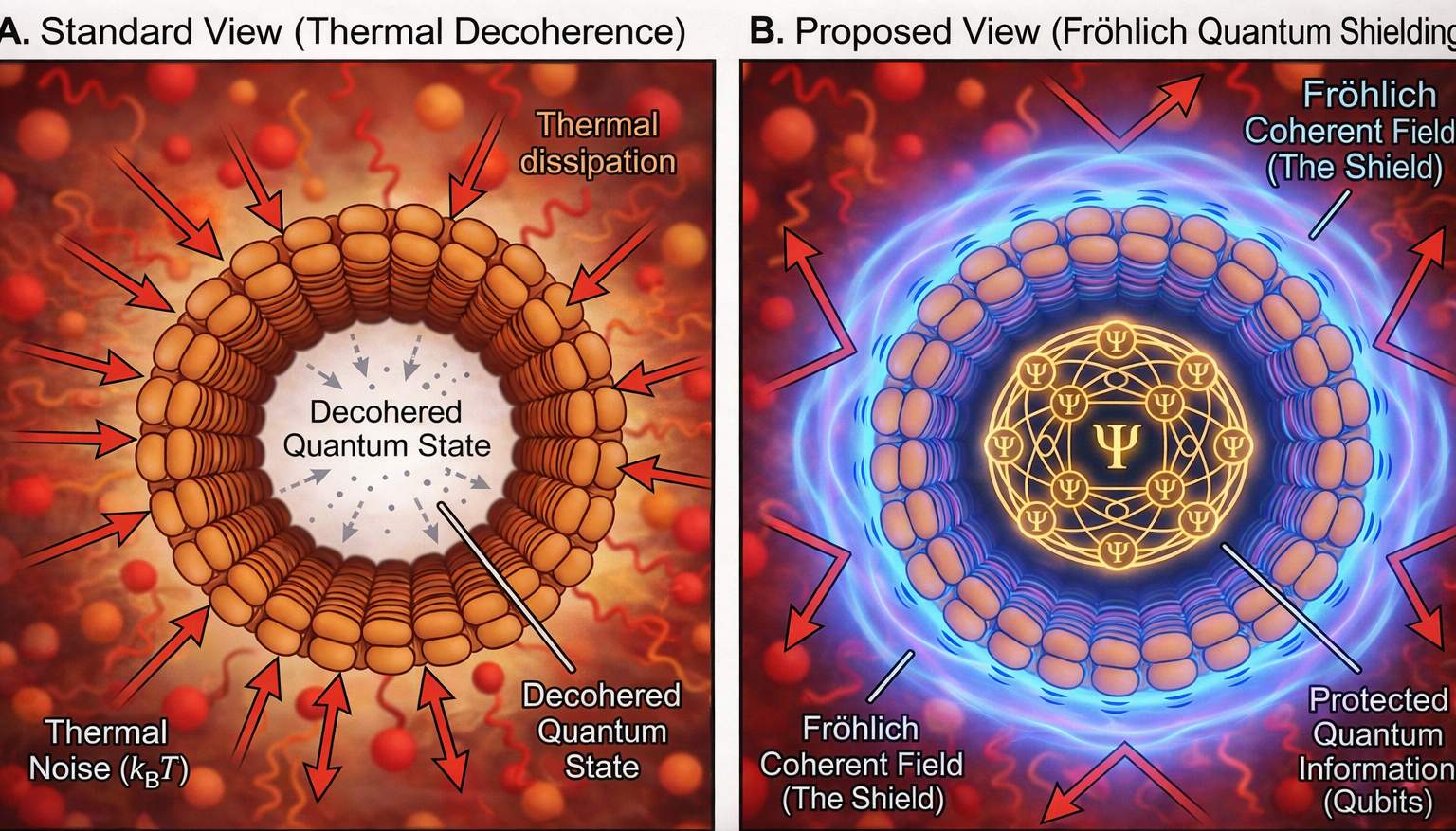
The precise physical nature of information remains an open wound on the side of modern physics. While often treated as an abstract mathematical quantity, recent developments in the Mass-Energy-Information Equivalence Principle argue for a more material interpretation: that information carries finite mass. Parallel to this, the field of quantum biology has long wrestled with the possibility of macroscopic coherent states within living systems, most notably through the Orchestrated Objective Reduction hypothesis. This article offers a perspective that attempts to weld these two speculative frameworks into a single, testable prediction. We explore the speculative hypothesis that if biological systems indeed sustain macroscopic quantum coherence, their eventual decoherence must—according to information conservation principles—result in a physical mass
defect. Unlike thermal dissipation, which is diffusive and slow, this ”information crash” should theoretically release a sharp, gravitationally detectable transient. Here, we outline the constraints of such an event and propose a conceptual protocol using near-field atom interferometry to isolate this signal from the thermal background. The goal of this perspective is to move the debate on biological information from philosophy into the realm of falsifiable experimental physics.
References
[1] Vopson, M. M. (2019). The mass-energy-information equivalence principle. AIP Advances, 9(9), 095206.
[2] Hameroff, S., & Penrose, R. (2014). Consciousness in the universe: A review of the ’Orch OR’ theory. Physics of Life Reviews, 11(1), 39-78.
[3] Fr ¨ohlich, H. (1968). Long-range coherence and energy storage in biological systems. International Journal of Quantum Chemistry, 2(5), 641-649.
[4] Abe, M., et al. (2021). Matter-wave atomic gradiometer interferometric sensor (MAGIS-100). Quantum Science and Technology, 6(4), 044003.
Downloads
Published
Versions
- 2026-03-20 (2)
- 2026-02-24 (1)
How to Cite
Issue
Section
License
Copyright (c) 2026 Riam Daou

This work is licensed under a Creative Commons Attribution 4.0 International License.