The Cosmic Ledger: A Thermodynamic Mechanism for Gravity and the Hubble Tension
DOI:
https://doi.org/10.59973/ipil.326Keywords:
Infodynamics, Data Compression, Gravity, Hubble Tension, Dark energy, Mass-Energy-Information EquivalenceAbstract
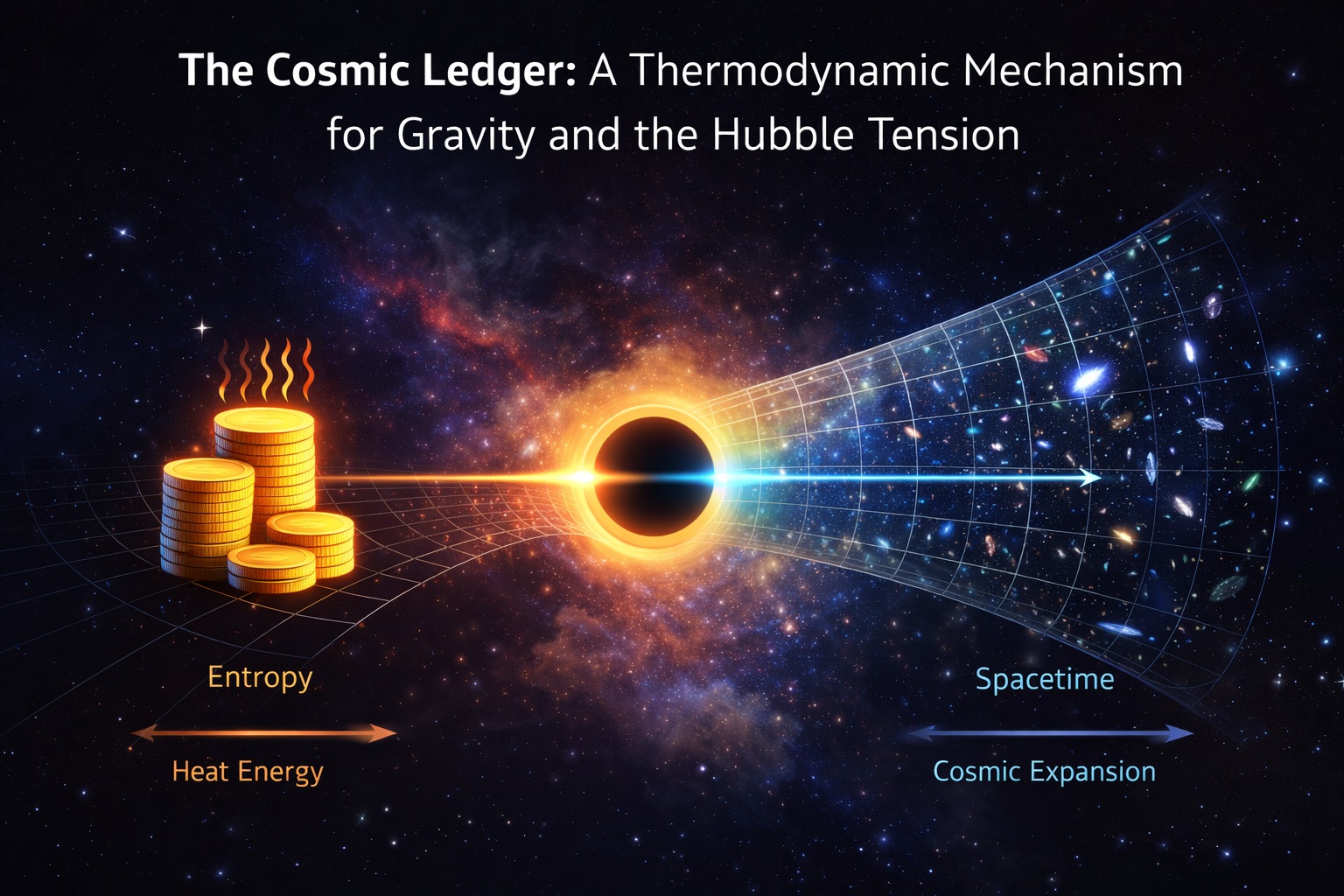
Dr. Melvin Vopson has proposed that gravity acts as a data compression mechanism within the framework of the Second Law of Infodynamics. We propose a speculative conceptual framework that augments this theory, suggesting that gravitational compression is a thermodynamic necessity dictated by the Law of Conservation of Energy. We introduce the Symbiotic Infodynamic Equilibrium (SIE) model, a qualitative hypothesis where the energy required for entropic State Realization (Sr) is offset by the compression of spatial informational mass. While Vopson’s original Second Law identifies information as a likely candidate for Dark Matter, it currently does not account for the accelerating expansion of the universe (Dark Energy). The SIE
model attempts to address this by introducing an inverse relationship: in cosmic voids where information density is negligible, the conservation of energy necessitates spatial decompression. This mechanism offers a potential thermodynamic derivation for Dark Energy and a novel, density-dependent perspective on the Hubble Tension. While Vopson’s original Second Law identifies information as a likely candidate for Dark Matter (mass accumulation), it currently does not account for the accelerating expansion of the universe (Dark Energy). The SIE model resolves this by introducing an inverse relationship: in cosmic voids where information density is negligible, the conservation of energy necessitates spatial decompression. This mechanism provides a thermodynamic derivation for Dark Energy and offers a novel, density-dependent resolution to the Hubble Tension.
References
[1] M. M. Vopson and S. Lepadatu, Second law of information dynamics, AIP Advances, vol. 12, no. 7, p. 075310, (2022)
[2] M. M. Vopson, Is gravity evidence of a computational universe?, IPI Letters, vol. 3, no. 1, pp. N6-N9, (2025)
[3] M. M. Vopson, The mass-energy-information equivalence principle, AIP Advances, vol. 9, no. 9, p. 095206, (2019)
[4] M. M. Vopson, Estimation of the information contained in the visible matter of the universe, AIP Advances, vol. 11, no. 10, p. 105317, (2021)
[5] J. D. Bekenstein, Black holes and entropy, Physical Review D, vol. 7, no. 8, pp. 2333-2346, (1973)
[6] L. Susskind, The World as a Hologram, Journal of Mathematical Physics, vol. 36, no. 11, pp. 6377-6396, (1995)
[7] A. G. Riess et al., A Comprehensive Measurement of the Local Value of the Hubble Constant, The Astrophysical Journal Letters, vol. 934, no. 1, p. L7, (2022)
Downloads
Published
How to Cite
Issue
Section
License
Copyright (c) 2026 Cody Hudock

This work is licensed under a Creative Commons Attribution 4.0 International License.