Thermodynamic Stability and Phase Transitions in the Nakamoto Consensus
DOI:
https://doi.org/10.59973/ipil.325Keywords:
Nakamoto Consensus, Thermodynamics, Phase Transitions, Statistical Mechanics, Kibble-Zurek Mechanism, Information Entropy, BitcoinAbstract
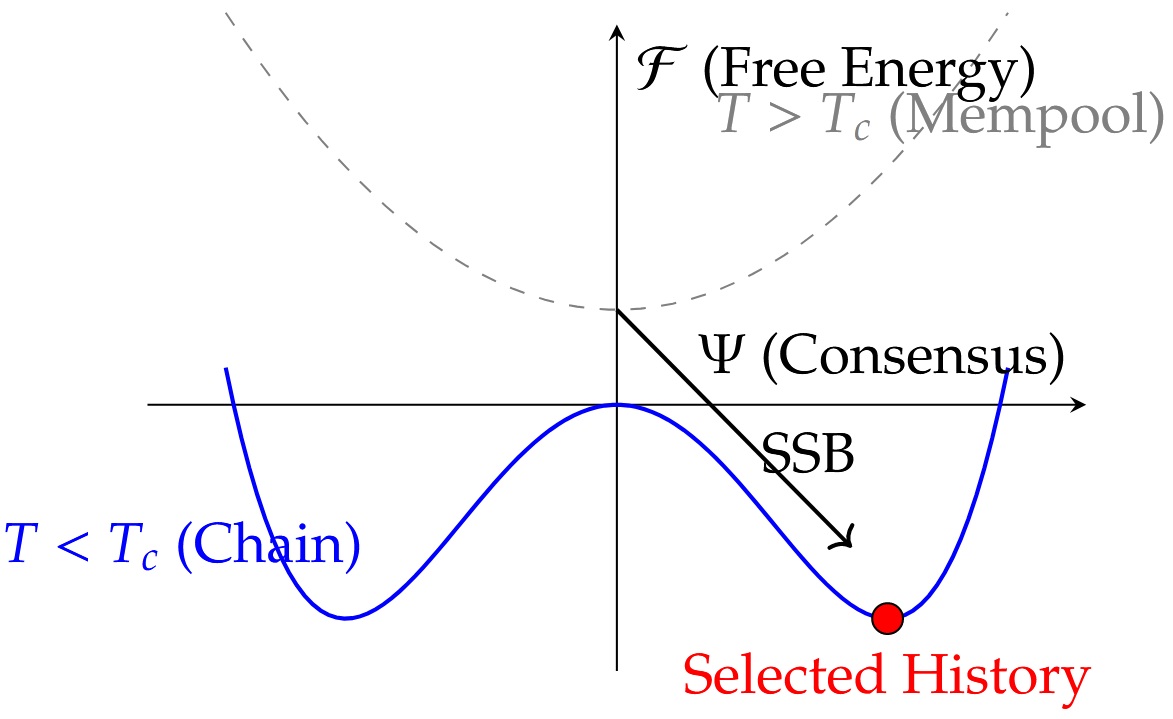
We propose a minimal physical model for the Nakamoto distributed consensus protocol based on non-equilibrium statistical mechanics. We treat the ledger as a one-dimensional lattice system where the consensus state is determined by the minimization of a thermodynamic cost function, analogous to the free energy in spin systems. In this framework, the ”Double Spend” problem is identified as a local symmetry breaking of the time-ordering parameter. We demonstrate that Proof-of-Work (PoW) acts as a dissipative external field that drives the system from a disordered ”liquid” phase (unconfirmed transactions) to an ordered ”crystalline” phase (immutable history). By defining an effective temperature derived from network latency and hashrate, we analyze the probabilistic finality of the ledger not as an event horizon, but as a correlation
length decay characteristic of massive field theories. Finally, we interpret chain forks as topological defects (domain walls) and show that the ”Halving” event acts as a sudden quench, subjecting the network to critical slowing down consistent with the Kibble-Zurek mechanism.
References
[1] Satoshi Nakamoto, Bitcoin: A Peer-to-Peer Electronic Cash System (2008), https://bitcoin.org/bitcoin.pdf
[2] Nick Szabo, Shelling Out: The Origins of Money, Satoshi Nakamoto Institute (2002)
[3] Charles H. Bennett, The Thermodynamics of Computation—a Review, International Journal of Theoretical Physics, Vol. 21 (1982)
[4] Rolf Landauer, Irreversibility and Heat Generation in the Computing Process, IBM Journal of Research and Development, Vol. 5 (1961)
[5] Ilya Prigogine, The End of Certainty: Time, Chaos, and the New Laws of Nature, The Free Press (1997)
[6] Claude E. Shannon, A Mathematical Theory of Communication, Bell System Technical Journal, Vol. 27 (1948)
[7] Melvin M. Vopson, The Mass-Energy-Information Equivalence Principle, AIP Advances, (9) 095206 (2019)
[8] Duncan J. Watts and Steven H. Strogatz, Collective dynamics of ’small-world’ networks, Nature, Vol. 393, pp. 440-442 (1998)
[9] V.L. Ginzburg and L.D. Landau, On the Theory of Superconductivity, Zh. Eksp. Teor. Fiz., Vol. 20, pp. 1064 (1950)
[10] Kenneth G. Wilson, The renormalization group: Critical phenomena and the Kondo problem, Rev. Mod. Phys., Vol. 47 (1975)
[11] Alain Connes and Carlo Rovelli, Von Neumann Algebra Automorphisms and Time-Thermodynamics Relation in Generally Covariant Quantum Theories, Classical and Quantum Gravity, Vol. 11, pp. 2899 (1994)
[12] Gerard ’t Hooft, Dimensional Reduction in Quantum Gravity, arXiv:gr-qc/9310026 (1993)
[13] Jacob D. Bekenstein, Black Holes and Entropy, Physical Review D, Vol. 7 (1973)
[14] T. W. B. Kibble, Topology of Cosmic Domains and Strings, J. Phys. A, Vol. 9 (1976)
[15] W. H. Zurek, Cosmological experiments in superfluid helium?, Nature, Vol. 317 (1985)
[16] John F. Nash, Ideal Money, Southern Economic Journal, Vol. 69, No. 1, pp. 4-11 (2002)
Downloads
Published
How to Cite
Issue
Section
License
Copyright (c) 2026 Pascal Ranaora

This work is licensed under a Creative Commons Attribution 4.0 International License.